

Major Research Themes
Our work sits under DDI Strategic Direction 3: Pathophysiology of Diabetes and Its Complications (2024–2028).
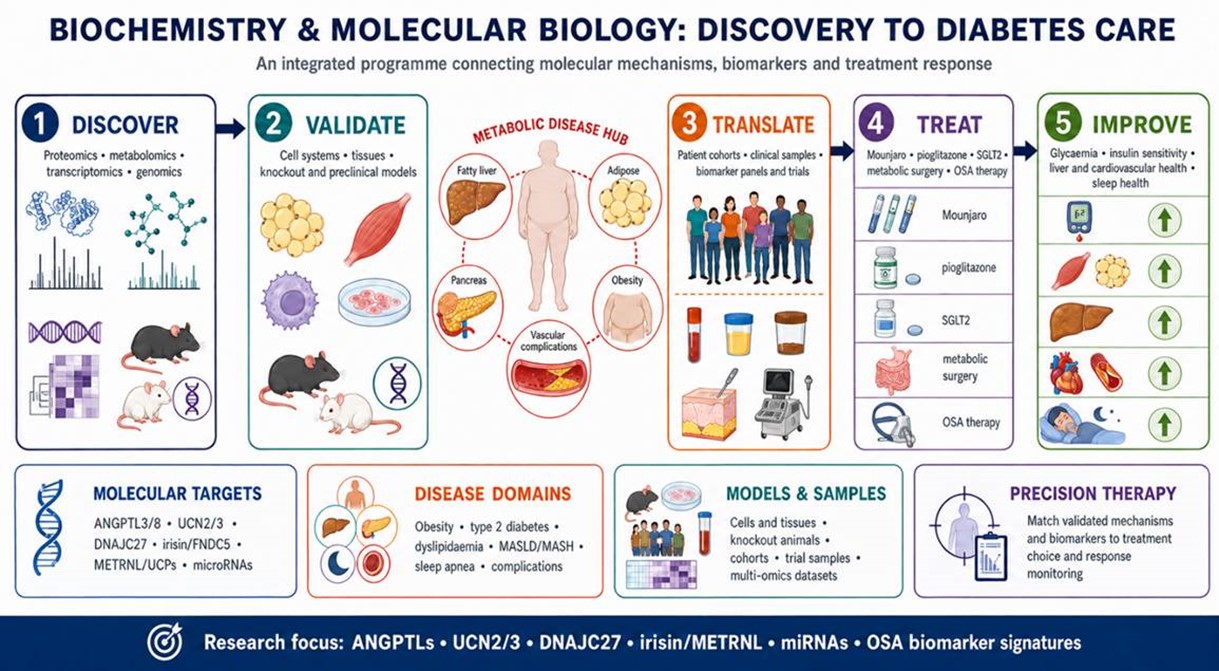
The program is to discover, develop and deliver therapeutic targets and biomarkers in metabolic disease, diabetes and its complications, and to test their translational potential.
Discover
Map candidate markers to the molecular and cellular pathways they act through, and identify the regulators involved.
Develop
Establish clinical relevance using gain- and loss-of-function models and build intervention strategies around the validated targets.
Deliver
Test therapeutic potential in pre-clinical models and in clinical studies, feeding directly into DDI’s translational research program.
Three projects carry this forward: the role of microRNAs in NAFLD/NASH progression and therapeutic targeting; the role of the ANGPTL protein family in NAFLD; and the impact of GLP-1/GIP dual agonists with pioglitazone on adipose tissue metabolism, insulin sensitivity and beta-cell function.
The ANGPTL8 Program
Since 2016, the department has built one of the most sustained research programs on ANGPTL8 anywhere in the region. It began with the observation that circulating ANGPTL8 tracks with hsCRP and metabolic syndrome, placing a lipid regulator squarely in an inflammatory context. From there the work moved into mechanism: miR-181d was shown to fall in obesity and to control ANGPTL3, which opened a route to regulating these proteins rather than merely measuring them. That route became two granted patents in 2021, covering microRNA-based suppression of ANGPTL8 and ANGPTL3 to treat dyslipidemia.
The picture that has emerged is of ANGPTL8 as a hub rather than a single-tissue protein. It acts on lipoprotein lipase at the endothelium, drives adipogenesis and lipid storage in the adipocyte, and contributes to hepatic fat accumulation and insulin resistance in the liver. The department also established that the postprandial rise in ANGPTL8 is driven by insulin rather than glucose, a distinction that matters how the protein is interpreted as a biomarker.
Over twenty publications have come out of this line of work, and it now anchors the 2024–2028 plan: hepatic ANGPTL8 is the target in rodent models of NAFLD and NASH, and ANGPTL8 is tracked as a readout of response to tirzepatide and pioglitazone.
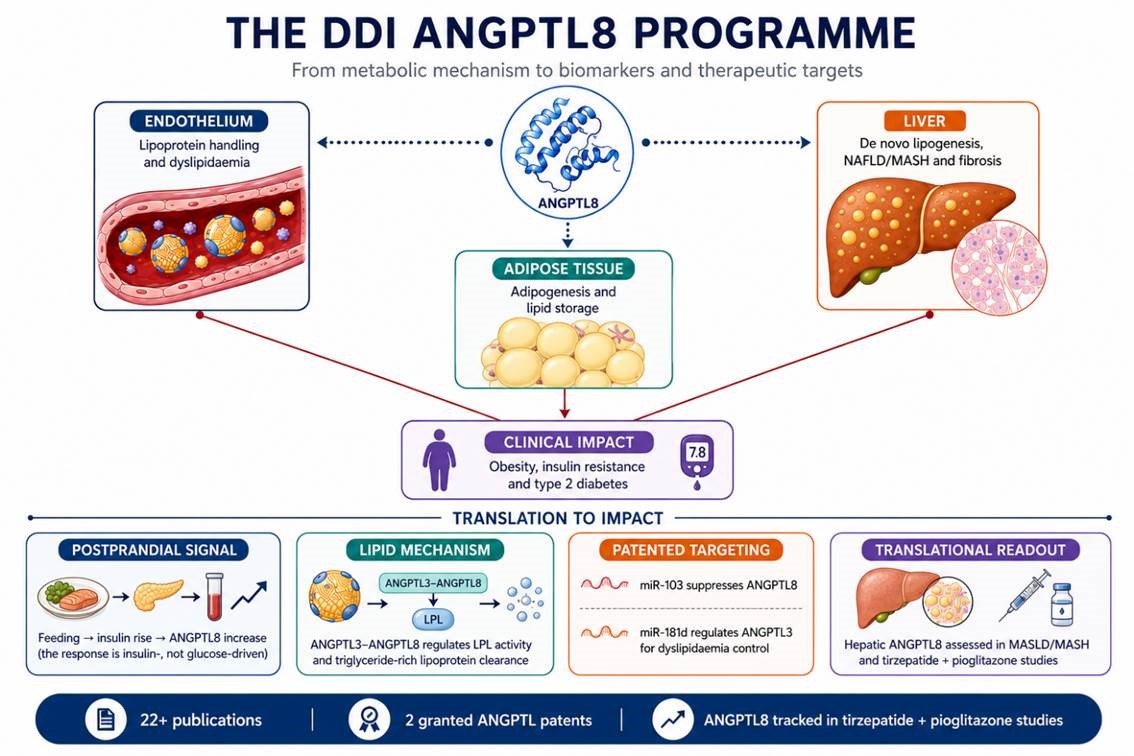
Updated 2026: the department has produced more than 22 ANGPTL-related publications and holds two granted ANGPTL microRNA patents; three additional granted US patents cover obstructive sleep apnea biomarkers.
Obstructive Sleep Apnea Diagnostics
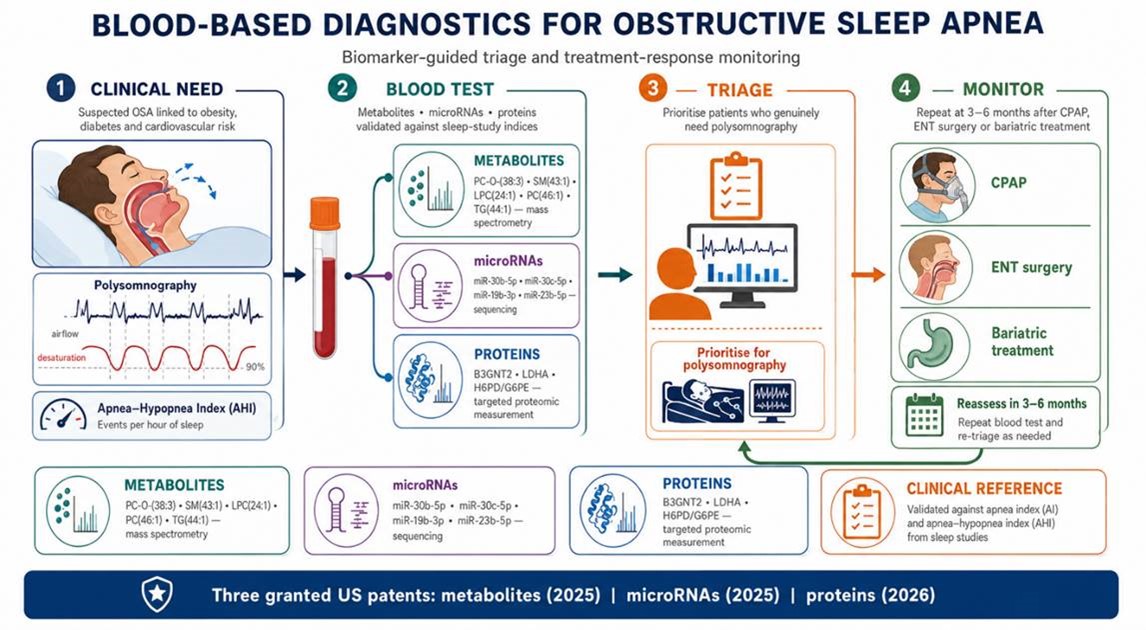
Sleep apnea affects roughly a fifth of the population and is tightly bound up with diabetes, obesity and cardiovascular disease. Diagnosis still depends on polysomnography — an overnight sleep study that is expensive, uncomfortable and, in practice, rationed by the number of sleep laboratory beds available. Most people with the condition are never diagnosed at all.
Working with the Sabah Al-Ahmad Center for Giftedness and Creativity, the department has taken a different approach: a blood test that identifies who genuinely needs a sleep study, and that can be repeated three to six months later to check whether the chosen treatment is working. If the marker has not shifted, the treatment is changed. The same panels apply across ENT multilevel surgery, CPAP and bariatric surgery.
Three independent marker classes have been developed and patented in the United States, each validated against apnea index and apnea-hypopnea index scores from formal sleep studies:

Metabolites — PC-O-(38:3), SM (43:1), LPC (24:1), PC (46:1) and TG (44:1), measured by mass spectrometry. US 12,390,156 B1, granted 19 August 2025.
MicroRNAs — miRNA-30b-5p, miRNA-30c-5p, miRNA-19b-3p and miRNA-23b-5p, measured by next-generation sequencing. US 12,480,161 B1, granted 25 November 2025.
Proteins — B3GNT2, LDHA and H6PD/G6PE, measured by mass spectrometry. US 12,644,894 B1, granted 2 June 2026.
All three name Abdulmohsen Alterki, Fahd Al-Mulla, Jehad Abubaker and Mohamed Abu-Farha as inventors. Because the markers are measurable in plasma, blood, urine or saliva, the same signatures could in principle be read by point-of-care biosensors — which is what would make population-scale screening realistic rather than aspirational.