

Heartsaver First Aid
The Heartsaver First Aid Course program goal is to teach rescuers to effectively recognize and treat adult emergencies in the critical minutes until emergency medical services personnel arrive.
Persons assigned to emergencies in the workplace or community as well as those who want to learn first aid. Some rescuers are required to take this course as part of their employer’s efforts to comply with OSHA regulations, i.e. corporate employees, security guards, airline personnel, lifeguards, and other individuals who want or need first aid training.
Learning Objectives
- Describe the principles of providing first aid
- Describe how the first aid rescuer protects himself/herself and others
- Describe how to assess a victim
- Describe what to do during an emergency on the following topics
- Medical Emergencies
- Injuries
- Environmental Emergencies
Who Should Attend
- Healthcare Providers (doctors and nurses)
- Paramedics
- Medical students
- Other
Duration
- Classroom-based Simulation course
- 3.5 contact hours
Register for Our Courses
Basic Life Support (BLS)
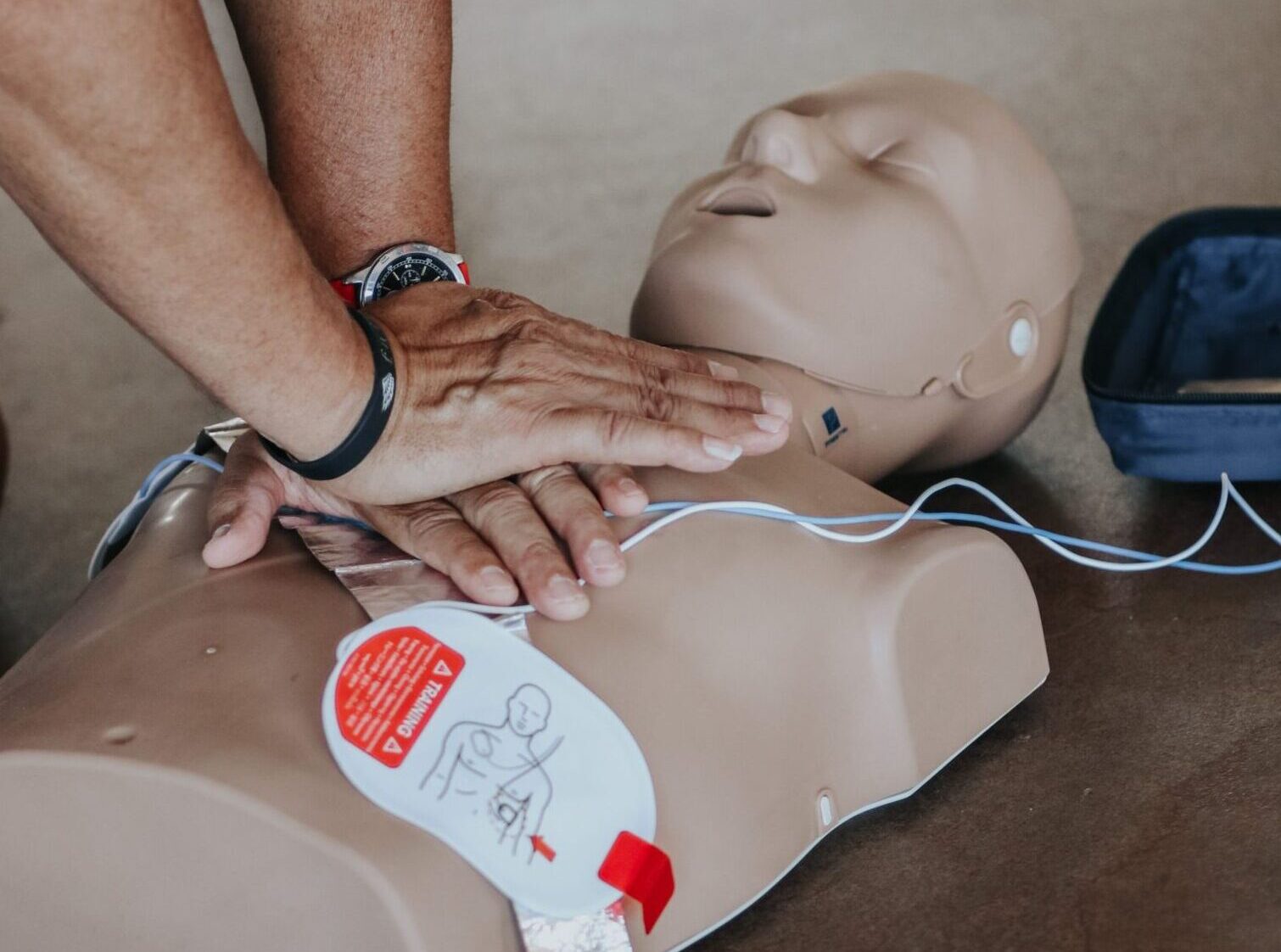
Welcome to the Basic Life Support (BLS) Provider Course. BLS is the foundation for saving lives after cardiac arrest. You will learn the skills of high-quality Cardiopulmonary Resuscitation (CPR) for victims of all ages and will practice delivery of these skills both as a single rescuer and as a member of a multi-rescuer team.
The skills you will learn in this course will enable you to: recognize cardiac arrest, activate the emergency response system early, and respond quickly and confidently.
Learning Objectives
- Describe the importance of high-quality CPR and its impact on survival
- Describe all of the steps of the Chain of Survival
- Apply the BLS concept of the Chain of Survival
- Recognize the signs of someone needing CPR
- Perform high quality CPR for adults
- Describe the importance of early use of an automated external defibrillator (AED)
- Demonstrate the appropriate use of an AED
- Provide effective ventilations by using a barrier device
- Perform high-quality CPR for infant
Who Should Attend
- Healthcare Providers (doctors and nurses)
- Paramedics
- Medical students
Duration
- Classroom-based Simulation course
- 4 contact hours
Register for Our Courses
Cardiopulmonary Resuscitation (CPR)
The goal is to teach participants to respond to and manage illnesses and injuries in a child or infant in the first few minutes until professional help arrives. The course covers the Four Steps of Pediatric First Aid and modules in Pediatric First Aid, Child/Infant CPR AED, Adult CPR AED, and Asthma Care Training.
The modular classroom-based course is designed to be flexible and allows to teach either Pediatric First Aid, CPR AED or both.
Learning Objectives
- Demonstrate how to assess the scene for safety
- Discuss how, when, and who to call for help
- Demonstrate how to assess patient who needs CPR
- Establish the importance and demonstrate the skill of high quality CPR for all ages
- Use the Automated External Defibrillator (AED)
- Perform on the mannequin how to relieve severe airway obstruction such as choking (adult, child, and infant)
Who Should Attend
- Healthcare Providers (doctors and nurses)
- Paramedics
- Medical students
- Camp counselors
- Child care workers
- Coaches
- Others responsible for children
Duration
- Classroom-based Simulation course
- 3.5 contact hours
Register for Our Courses
Heartsaver First Aid and CPR AED (Full Course)
The Heartsaver First Aid and CPR AED Course teaches the participants to effectively recognize and treat adult, child and infant emergencies in the critical minutes until emergency medical services personnel arrive. The hands-on CPR skills training prepares you to respond to breathing and cardiac emergencies. It also teaches the skills needed to provide care for victims of sudden cardiac arrest through the safe use of an automated external defibrillator (AED).
Persons assigned to emergencies in the workplace or community as well as those who want to earn first aid, cpr-aed. Some rescuers are required to take this course as part of their employer’s efforts to comply with OSHA regulations, i.e. corporate employees, security guards, airline personnel, lifeguards, gym instructors and other individuals who want or need first aid and CPR-AED training.
Learning Objectives
- Describe the principles of providing first aid
- Describe how the first aid rescuer protects himself/herself and others
- Describe how to assess a victim
- Describe what to do during the following emergencies
- Medical
- Environmental
- Injuries
- Describe what to do after the emergency
- Describe how to assess the scene for safety
- Describe how, when, and who to call for help
- Demonstrate how to assess patient who needs CPR
- Establish the importance and demonstrate the skill of high quality CPR for all ages
- Demonstrate safe use of Automated External Defibrillator
- Demonstrate on a mannequin how to relieve severe airway obstruction such as choking (adult, child, and infant)
Who Should Attend
- Healthcare Providers (doctors and nurses)
- Paramedics
- Medical students
- Others
Duration
- Classroom-based Simulation course
- 7 contact hours
Register for Our Courses
Heartsaver Pediatric First Aid and CPR AED
The goal is to teach participants to respond to and manage illnesses and injuries in a child or infant in the first few minutes until professional help arrives. The course covers the Four Steps of Pediatric First Aid and modules in Pediatric First Aid, Child/Infant CPR AED, Adult CPR AED, and Asthma Care Training.
This essential classroom-based course is designed to be flexible and allows to teach either Pediatric First Aid, CPR AED or both.
Learning Objectives
Pediatric First Aid Basics
- Demonstrate how to stop bleeding and bandaging
- Demonstrate how to treat severe allergic reactions using Epi-pen
- Describe how to assist someone with asthma including how to assemble an inhaler
- Discuss what to do if a child or infant drowned
- Outline first aid measures for bites and stings
- Explain how to treat simple burns
Pediatric First Aid Basics
- Demonstrate CPR and AED for children
- Explain how to help a choking child
- Demonstrate CPR for infants
- Explain how to help a choking infant
- Demonstrate CPR and AED for adults (optional)
- Demonstrate how to help a choking adult (optional)
Who Should Attend
- Healthcare Providers (doctors and nurses)
- Paramedics
- Medical students
- Camp counselors
- Child care workers
- Coaches
- Others responsible for children
Duration
- Classroom-based Simulation course
- 6 contact hours
Register for Our Courses
Advanced Cardiac Life Support
The goal of the Advanced Cardiac Life Support (ACLS) Provider Course is to improve outcomes for adult patients with cardiac arrest, as well as other cardiopulmonary emergencies, through provider training. This useful ACLS Provider course is designed for healthcare providers who either direct or participate in the management of cardiopulmonary arrest as well as other cardiovascular emergencies.
Through didactic instruction and active participation in simulated cases, the students will enhance their skills and clinical decision-making abilities for the diagnosis and treatment of cardiopulmonary arrest, acute arrhythmia, stroke and acute coronary syndromes.
Learning Objectives
- Integrate Basic Life Support (BLS) Survey and Primary Survey in patient assessment and care
- Demonstrate high-quality cardiopulmonary resuscitation with AED for adult victims
- Use the ACLS Algorithms effectively
- Observe effective resuscitation team dynamics
- Demonstrate immediate post-cardiac arrest care
- Discuss how to treat a Stroke and ACS patient
Who Should Attend
- Healthcare Providers (doctors and nurses)
- Dentists
Duration
- Classroom-based Simulation course
- 14 contact hours
Register for Our Courses
Safe Injection Techniques
This course revises the knowledge and guiding principles for safe ID (intradermal); SC (subcutaneous); and IM (intramuscular) injections. It outlines procedures used to select appropriate sites, considers the medication to be given as well as patient’s special needs that may affect the choice for injection site.
Issues related to preparation of the patient’s skin and equipment to be used and ways to reduce discomfort and pain during the procedure are also covered.
Learning Objectives
- Identify the safe anatomical sites for ID, SC and IM injections
- Locate specific muscles for IM injections and explain the rationale for their use
- Verbalize reason for method used for skin preparation
- Discuss ways to reduce patient discomfort during an injection
- Describe patient care required to avoid complications associated with injections
- Perform the procedure for ID, SC, IM injections using practice manikins
Who Should Attend
- Healthcare Providers (doctors and nurses)
- Paramedics
- Medical Students
Duration
- Classroom-based Simulation course
- 3 contact hours
Register for Our Courses
Vascular Access
Vascular access training is an important opportunity for education and helps provide the best ways for vascular accessibility during, both, an emergency and non-emergency case, to manage the situation and save the life of a patient.
Learning Objectives
- Define what is venous cannulation and its indications
- Verbalize possible sites for venous cannulation
- Demonstrate appropriate patient assessment: physical and psychological status
- Determine what cannula to use
- Demonstrate procedure on peripheral IV cannulation
- Demonstrate proper waste management and infection control
- Identify possible complications and how to intervene and manage
Who Should Attend
- Healthcare Providers (doctors and nurses)
- Paramedics
- Medical Students
Duration
- Classroom-based Simulation course
- 3 contact hours
Register for Our Courses
Nasogastric Tube Insertion (NGT)
The placement of a Nasogastric Tube Insertion (NGT) can be uncomfortable for the patient if the patient is not adequately prepared with anesthesia to the nasal passage and specific instructions on how to cooperate with the operator during the procedure. Thus, participants will learn the technique how to insert the NGT to patients following the appropriate procedures.
Learning Objectives
- Define what NGT is
- Verbalize what are the indications and contraindications
- Demonstrate adequate preparation equipment required for the procedure
- Demonstrate adequate preparation of patient prior to the procedure
- Demonstrate procedure of NGT insertion in a manikin
Who Should Attend
- Healthcare Providers (doctors and nurses)
- Paramedics
- Medical Students
Duration
- Classroom-based Simulation course
- 2 contact hours
Register for Our Courses
Basic Suturing
In this Basic Suturing course, the suture techniques used is reviewed, the techniques of suture placement for each type of these techniques is described as well. Moreover, the rationale behind choosing the type of suture is also reviewed, including the advantages and disadvantages of each suture technique. After taking this course, the student should have a clear understanding of how and why particular sutures are chosen, and form an appreciation of the basic methods of placing each type of suture.
Learning Objectives
- Describe the principles of wound management
- Demonstrate the preparation for a simple suturing technique
- Demonstrate technique while preparing and suturing a laceration model/simulation pad
- Demonstrate basic suturing techniques on a simulation model/pad
Who Should Attend
- Healthcare Providers (doctors and nurses)
- Paramedics
- Medical Students
Duration
- Classroom-based Simulation course
- 3 contact hours
Register for Our Courses
Advanced Suturing
This intensive skills workshop is designed for nurse practitioners, medical students and physician assistants who are proficient in performing simple interrupted sutures and wish to build on their skills. The Advanced Suturing course will provide opportunity to practice the following suturing techniques:
- Simple Continuous
- Continuous Locking
- Vertical Mattress
- Horizontal Mattress
- Embedded Subcuticular
- Hand ties
Working on cadaveric specimens to simulate real life scenarios, enabling participants to get hands on experience with most of the above-mentioned techniques.
Learning Objectives
- Identify different suture materials and needles
- Demonstrate wound closure techniques
- Describe suture after care
- Discuss management of more complex wound closure
- Demonstrate more advanced wound closure technique
Who Should Attend
- Healthcare Providers (doctors and nurses)
- Paramedics
- Medical Students
Duration
- Classroom-based Simulation course
- 3 contact hours
Register for Our Courses
Urinary Catheterization
Urinary Catheterization is a procedure of inserting a hollow tube through the urethra into the bladder to remove urine. The goal of this activity is to provide the participants with the experience of performing urinary catheterization in both male and female simulated manikins before performing the procedure on real patients.
Learning Objectives
- Describe the appropriate assessment to be performed prior to performing the procedure
- List all equipment and supplies required for the procedure
- Demonstrate the proper technique for performing urinary catheterization procedure
- Describe appropriate infection control procedures that must be followed when performing the procedure
- List at least 3 possible complications and how to manage or intervene
Who Should Attend
- Healthcare Providers (doctors and nurses)
- Paramedics
- Medical Students
Duration
- Classroom-based Simulation course
- 3 contact hours
Register for Our Courses
Vital Signs
Patient observations, or Vital Signs, traditionally consist of the following: blood pressure, pulse rate, temperature and respiratory rate.
Patient observations play a very important role in patient care. They allow the patients’ progress to be monitored and they ensure prompt detection of adverse events or delayed recovery. Consequently, participants will learn the proper way to take Vital Signs.
Learning Objectives
- Describe what vital signs is and its components
- Compare the normal and abnormal findings for different age groups
- Identify its clinical and hemodynamic indications
- Identify all the preparations prior to the procedure
- Demonstrate successfully how to take vital signs
Who Should Attend
- Healthcare Providers (doctors and nurses)
- Paramedics
- Medical Students
Duration
- Classroom-based Simulation course
- 2 contact hours
Register for Our Courses
Wound Management
The skin is the largest organ of the body, making up to 16% of the body weight. It has several vital functions which includes: immune function, temperature regulation, sensation and vitamin production.
The skin is a dynamic organ in a constant state of change; cells of the outer layers are continuously shed and replaced by inner cells moving to the surface.
Learning Objectives
- Describe parameters for proper assessment and wound staging/identification and select possible treatment for different types of wounds
- Discuss evidence based practices for wound management
- Demonstrate skills on wound management (wound cleansing/ choice of dressing)
- Summarize the key information of the Clinical Evidence
- Grading Criteria and Wound Care assessment tool
Who Should Attend
- Healthcare Providers (doctors and nurses)
- Paramedics
- Medical Students
Duration
- Classroom-based Simulation course
- 3 contact hours
Register for Our Courses
Phlebotomy
The aim of the course is to ensure all Nursing and Allied Health Staff who perform Phlebotomy are provided with relevant evidenced based skills training which will equip them to provide high
quality care that is consistent throughout the hospital.
Learning Objectives
- Discuss criteria for vein selection and demonstrate selection of vein for the procedure
- Select & prepare the necessary equipment/supplies for the procedure
- Demonstrate the correct technique for skin preparation and accessing the vein
- Describe appropriate actions to prevent and manage complications
- Have an understanding of the legal and ethical considerations of phlebotomy
Who Should Attend
- Healthcare Providers (doctors and nurses)
- Paramedics
- Medical Students
Duration
- Classroom-based Simulation course
- 3 contact hours
Register for Our Courses
Airway Management
The American Heart Association Airway Management Course is designed for healthcare providers who must be proficient in using airway devices on adults in or out of the hospital. The goal is to equip students with ways and techniques on proper Airway Management and breathing compromise.
Learning Objectives
- Perform Bag-Mask Ventilation and Insert Airway Adjuncts
- Insert Laryngeal Mask Airway (LMA)
- Insert Endotracheal Tube (ETT)
- Describe how to confirm proper placement of airway devices
Who Should Attend
- Healthcare Providers (doctors and nurses)
- Paramedics
- Medical Students
Duration
- Classroom-based Simulation course
- 3 contact hours
Register for Our Courses
ECG & Pharmacology
ECG recognition skills and drug treatment knowledge have been identified as the key gaps in knowledge for healthcare providers. ECG and Pharmacology is a classroom-based course that the AHA has developed to bridge these gaps.
The course is designed with the goal of providing an option for the ACLS students who were identified through the ACLS “Pre-course Self-Assessment” as the need to improve ECG recognition skills and/or drug treatment knowledge, or for the ACLS students who, in general, need to refresh their skills and knowledge.
This course is also intended for any healthcare provider needing to learn ECG recognition skills and/or pharmacology.
Learning Objectives
- Explain heart anatomy and basic electrophysiology
- Explain normal ECG measurements
- Recognize and understand basic arrhythmias
Who Should Attend
- Healthcare Providers (doctors and nurses)
- Paramedics
- Medical Students
Duration
- Classroom-based Simulation course
- 2 contact hours